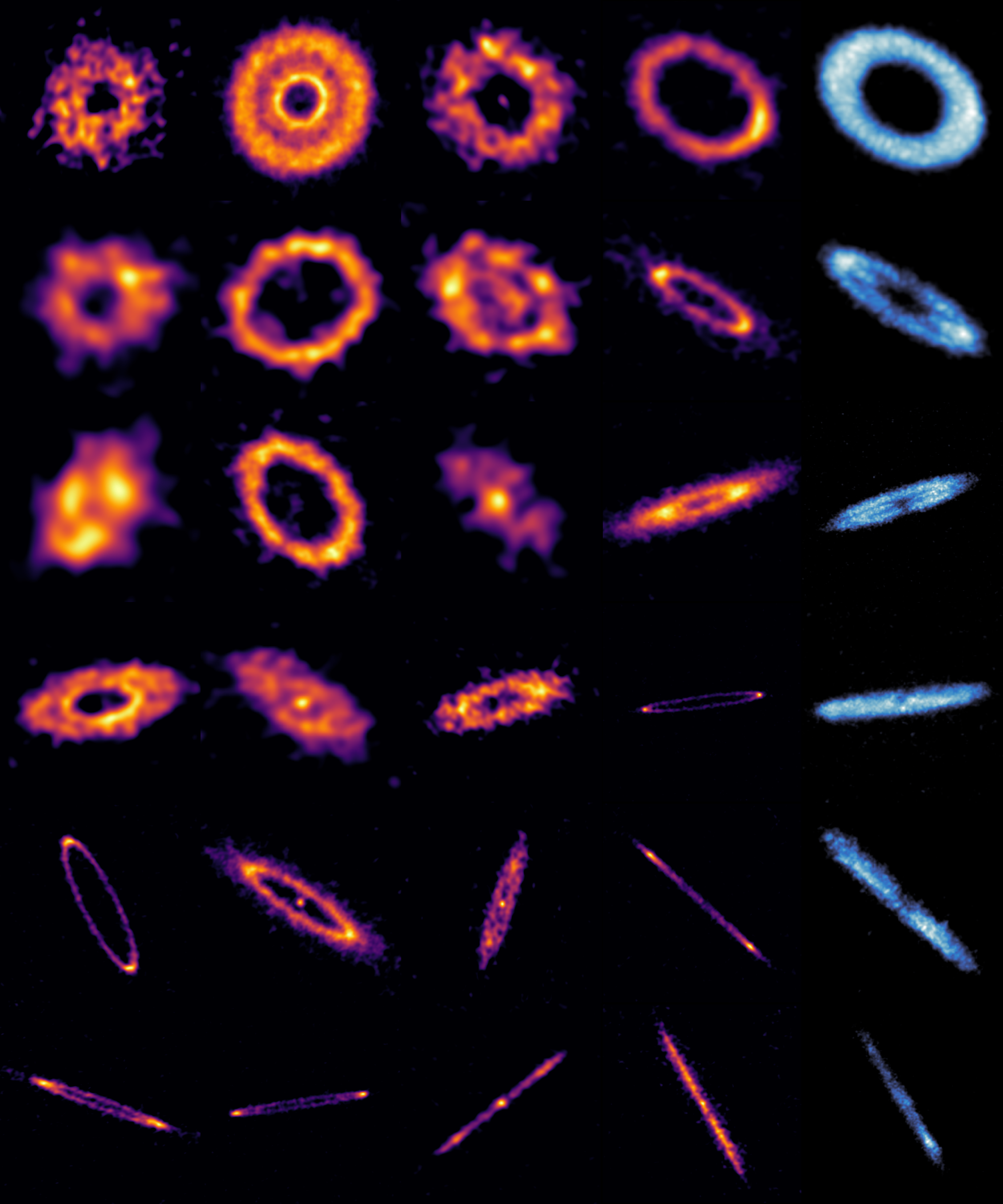
HD 109573 (HR 4796)
Dust emission
HD 9672 (49 Ceti)
CO Gas emission
HD 39060 (β Pic)
Dust emission
HD 145560
Dust emission
HD 131835
CO Gas emission
HD 15257
Dust emission
HD 131488
Dust emission
HD 121617
Dust emission
HD 170773
Dust emission
TYC 9340-437-1
Dust emission
HD 92945
Dust emission
HD 107146
Dust emission
HD 14055 (γ Tri)
Dust emission
HD 32297
Dust emission
HD 218396
Dust emission
HD 131488
CO Gas emission
HD 61005
Dust emission
HD 121617
CO Gas emission
HD 206893
Dust emission
HD 131835
Dust emission
HD 84870
Dust emission
HD 15115
Dust emission
HD 9672 (49 Ceti)
Dust emission
HD 161868
Dust emission
HD 197481 (AU Mic)
Dust emission
HD 10647 (q1 Eri)
Dust emission
HD 76582
Dust emission
HD 32297
CO Gas emission
HD 39060 (β Pic)
CO Gas emission
HD 95086
Dust emission
Debris discs show us what happens to planetary systems from about 10 million years to more than a billion years after their formation. They are analogues of our Solar System’s Kuiper Belt, and encode key information about how these planetary systems form and evolve over billions of years. Their structures can hint at the presence of planets shaping them via gravitational interactions. By imaging these belts, we access a unique window to study the outer regions of planetary systems.
About the Survey
The ARKS programme uses the Atacama Large Millimeter/submillimeter Array (ALMA) to provide the first high-resolution views of a large sample of these adolescent planetary systems, through their debris discs, also known as exoKuiper belts. With a combination of new and archival data, we have analysed a diverse sample of 24 exoKuiper belts. In the initial series of ten papers, we study:
- The radial and vertical structure of the dust belts,
- The density, temperature, and kinematics of molecular gas,
- The relationship between the different dust populations seen in radio and optical light,
- The asymmetries present in the dust belts, and
- The unusual debris disks around HD 121617 (which has a pronounced dust arc and interesting gas kinematics) and HD 131835 (which has two belts that flip in brightness between millimetre and scattered light).
Check out our press release ALMA Reveals Teenage Years of New Worlds